
 Vee Richardson
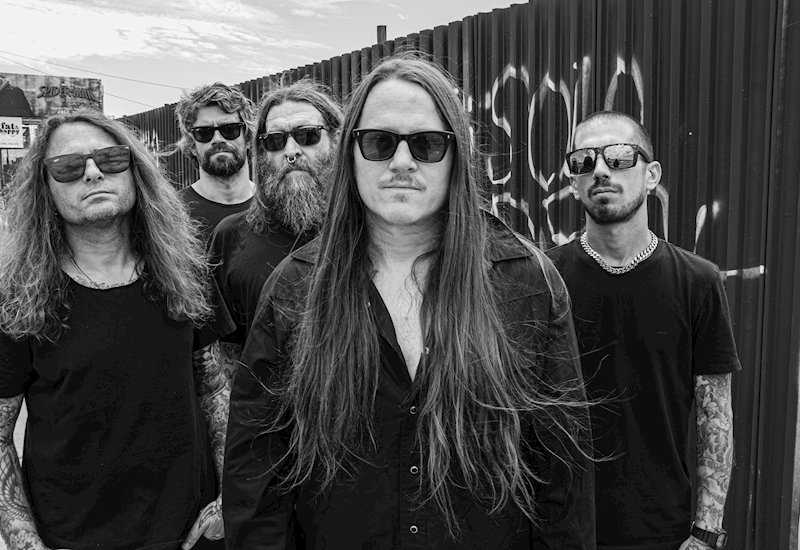
After thirty-one years and eleven albums, Darkest Hour have more than earned a legacy. With Suffer Divine, however, the Washington D.C. metallers are far more interested in what comes next than preserving what came before. Guitarist Mike Schleibaum talks nostalgia, metalcore’s shifting identity and why, after three decades of experimentation, sounding like Darkest Hour might be enough.
Legacy is supposed to be what remains after the work is done. Darkest Hour’s problem is that the work is nowhere near finished. Thirty-one years and eleven albums into their career, the Washington D.C. band occupy an unusual place in heavy music: their influence belongs to metalcore history, while the band itself remains stubbornly rooted in the present. The collision of melodic death metal, traditional heavy metal and DIY hardcore that once made Darkest Hour difficult to neatly categorise has long since become part of the genre’s vocabulary, passed through generations raised on records like Undoing Ruin and Deliver Us. Inevitably, words such as veteran, pioneer and legacy band have followed.
There is something oddly funereal about that last sentence. It sounds like praise but also suggests that a band’s defining contribution has already been made and that everything which follows exists in the shadow of something better remembered. Suffer Divine makes that assumption difficult to sustain. ‘A Story Of Redemption’ carries much of the melodic vocabulary associated with Deliver Us without sounding like an attempt to reconstruct 2007, while ‘The Unforgiving Hand’ lets an extended guitar lead hang in the air before the band erupts behind it. Its transition into ‘Tribalist’ is one of the album’s most satisfying turns, and ‘Everyday Horrors’ is simply stacked with the kind of riffs that make album eleven feel considerably less like an obligation.
That balance between recognition and novelty was deliberate. “You want someone to feel a little nostalgic when they hear the record,” guitarist Mike Schleibaum explains, “but then you also want them to feel like it’s brand new and exciting.” After thirty-one years, finding ideas is not necessarily the difficult part. Darkest Hour are still constantly writing; the harder question is whether those ideas can become something worthy of sitting alongside ten previous records. “Can you make a Darkest Hour record, and can you make one that needs to exist?” Schleibaum asks. “Now that I get it.”
Suffer Divine grew quickly from the momentum left behind by 2024’s Perpetual | Terminal. Where that record arrived after a seven-year gap, its successor came from a band already touring, writing and absorbing whatever was happening around them. “We’re out there with modern bands, soaking up everything that’s happening, and we immediately started thinking, ‘Oh man, I wish we also did this. I wish we also did this.’” Crucially, that instinct was additive rather than corrective. “It wasn’t like, ‘I wish we did this and not this.’ It was more, ‘I wish we had also tried this.’” The result is heavier than its predecessor, with more melodic weight returning to the guitars and the band leaning towards what Schleibaum calls a “classic, direct melodic death-metal style”.
That apparent return to familiar territory raises the central tension around Darkest Hour in 2026: how much of sounding like yourself is continuity, and at what point does continuity get mistaken for nostalgia?
For Schleibaum, even the idea that Darkest Hour might now qualify as a legacy band arrived surprisingly late. “It never even occurred to me that Darkest Hour could be this thing called a ‘legacy band’,” he admits. The realisation came during a recent label meeting for Suffer Divine, where he began to recognise how differently the band’s history looked from outside it. To the people around that table, Darkest Hour were a group formed in the 1990s who had remained active long enough for younger musicians and crew members to have formative stories attached to them: a first show, a first tour, an early encounter with heavy music.
“They see us as like, ‘Wow, this older band that is still existing and putting out records.’ Wow, they’re from the ’90s.’ And I don’t feel like I’m from the ’90s. I just feel like I’m here now.”
That line gets to the problem with legacy bands better than any grand definition could. Darkest Hour unquestionably possesses a legacy, but describing the band itself as a legacy risks turning longevity into the past tense. “We’re not really that stoked on the words ‘legacy’ or ‘nostalgia’,” Schleibaum says. “Really, we’re trying to push past that as artists and as people.” At the same time, he is careful not to dismiss what surviving for thirty-one years represents. “You don’t want to take lightly the sacrifices that you’ve made. So if the word ‘legacy’ in front of it gets people to take us more seriously, fine.”
Then any danger of taking the label too seriously disappears. “But we are the guys that have been around forever and will come to your backstage and steal all your beer. We’re still both of those things.”
That same refusal to become overly precious about Darkest Hour’s history extends to the music itself. Suffer Divine may draw heavily from the band’s established sound, but it still leaves room for ideas that do not immediately fit the mould.
‘The Unforgiving Hand’ is perhaps the clearest example, its opening stretching further than convention suggests it should before giving way to what Schleibaum describes as an “emotive explosion”. He calls it “sort of like a Pink Floyd-y thing” and admits the structure initially sounded strange even inside the band. “I’m always the guy in the band who’s like, ‘Hey, but what about this?’ And they all look at me like, ‘Dude, you’re crazy.’” The idea survived because it worked. “One of the biggest rules when you’re making a record is: once something feels right and good, you don’t need to change that.”
Its collision with ‘Tribalist’ fits the same philosophy. Schleibaum describes sequencing in terms of “ocean currents”, with songs arranged to create “waves of feeling” rather than one unbroken level of intensity. That willingness to let ideas pull against one another also shapes the writing process. Schleibaum and vocalist John Henry, who started Darkest Hour together as teenagers, may carry much of the band’s original sonic DNA, but the current line-up remains collaborative. Schleibaum jokingly calls it a “Ninja Turtles-esque division of power”, with different personalities pushing songs around until something recognisably Darkest Hour emerges.
After eleven records, even sounding recognisably Darkest Hour can become a trap. Schleibaum is conscious of repetition, but he is more wary of deliberately trying to manufacture the band’s own identity. “You want to focus more on what you like? What’s turning you on? And less on trying to make something sound like it’s Darkest Hour, because when you do that, it never goes well. It just sounds like everything you’ve done before.”
The irony is that listeners will make those connections anyway. One song recalls Deliver Us, another The Human Romance, while somebody else hears an entirely different period of the band. Eventually, separating influence from identity becomes pointless. “Then you start to say, ‘You know what? Maybe it just sounds like us.’”
Nowhere is that clearer than on Suffer Divine’s closing track. ‘A Story Of Redemption’ carries an Iron Maiden-esque melodic quality that sits comfortably beside the guitar language of Deliver Us, a similarity Schleibaum makes no attempt to disguise. “There are a lot of similarities. Trust me,” he laughs. “We’re playing in the same key. We’re playing around with the same melodic style. We’re playing around with a lot of the same harmonies. We’re doing that on purpose, because that’s the sound of the band.”
There is a difference between nostalgia and continuity. Rebuilding Deliver Us because of what that record represents would be one thing. Accepting that its musical language never stopped belonging to Darkest Hour is another. In the years since, the band have pushed towards different extremes, sometimes heavier and sometimes more melodic. Schleibaum sees Suffer Divine not as a retreat from those experiments, but as the result of them. “I think we’ve just gotten to the point where we’re so far away that now we’ve experimented ourselves back into the same path.”
Darkest Hour’s relationship with the word metalcore has been similarly circular. Asked about criticism that some of the new material leans too heavily towards that side of the band, Schleibaum fires back almost immediately: “What other side should we be on if we’re not on a metalcore side?” The genre Darkest Hour was once folded into is not the same genre it is now. “When we were dubbed metalcore, it was completely different than it is now,” he says. Their own lineage was always broader anyway, drawing on heavy metal, death metal and DIY hardcore, right back to the vegan straight-edge movement of the early 1990s. “We didn’t like the term either. But it’s funny now that there are so many subgenres; later, we just don’t care anymore.”
That continuity becomes most obvious live. After recently playing two Suffer Divine songs in Colombia, Schleibaum was struck by how naturally they sat beside material written decades earlier. “They’re just in the setlist, and they just fit right in.” He remembers looking at Henry and saying, “Dude, we were writing songs when you were sixteen, and we’re still writing songs that fit in, but they’re all good.” Schleibaum describes the catalogue as a “family tree”: records with distinct personalities but enough shared DNA to belong together. Suffer Divine neither severs itself from Darkest Hour’s history nor treats that history as sacred ground. It simply occupies its place within it.
The same lack of distance carries into the band’s relationship with the people around them. After shows, Darkest Hour can still be found at the merchandise table, meeting fans, something Schleibaum values rather than regards as an obligation. “We are lifer lovers of heavy metal,” he says. “We would be at the show too if we weren’t playing.” For a band now old enough to hear stories about the effect its music has had on other people’s lives, that direct contact matters. “When you go out to the table, it doesn’t feel like you’re giving. It feels like you’re getting back.”
There is an obvious temptation to call that legacy, but Schleibaum describes influence in less grand terms. Darkest Hour themselves were shaped by local bands whose importance was intensely personal rather than historically recognised. “We were inspired by a bunch of local bands that probably nobody cares about around the world, but they changed our lives,” he says. More than three decades later, Darkest Hour has lived long enough to occupy that position for somebody else.
“That’s kind of the best thing you can do: inspire people and make them want to continue, and grow another little branch of the community you’re trying to build by being in a band and touring and doing all this stuff.”
It is an understated way to describe thirty-one years of influence, and perhaps that suits Darkest Hour better than the grand language surrounding legacy ever could. They are old enough to have become part of metalcore’s history, but Suffer Divine does not sound like the work of a band interested in behaving like history. The past is audible because, after eleven records, it would be strange if it were not. What matters is that Darkest Hour still sound more interested in finding the next riff than deciding what the last thirty-one years are supposed to mean.