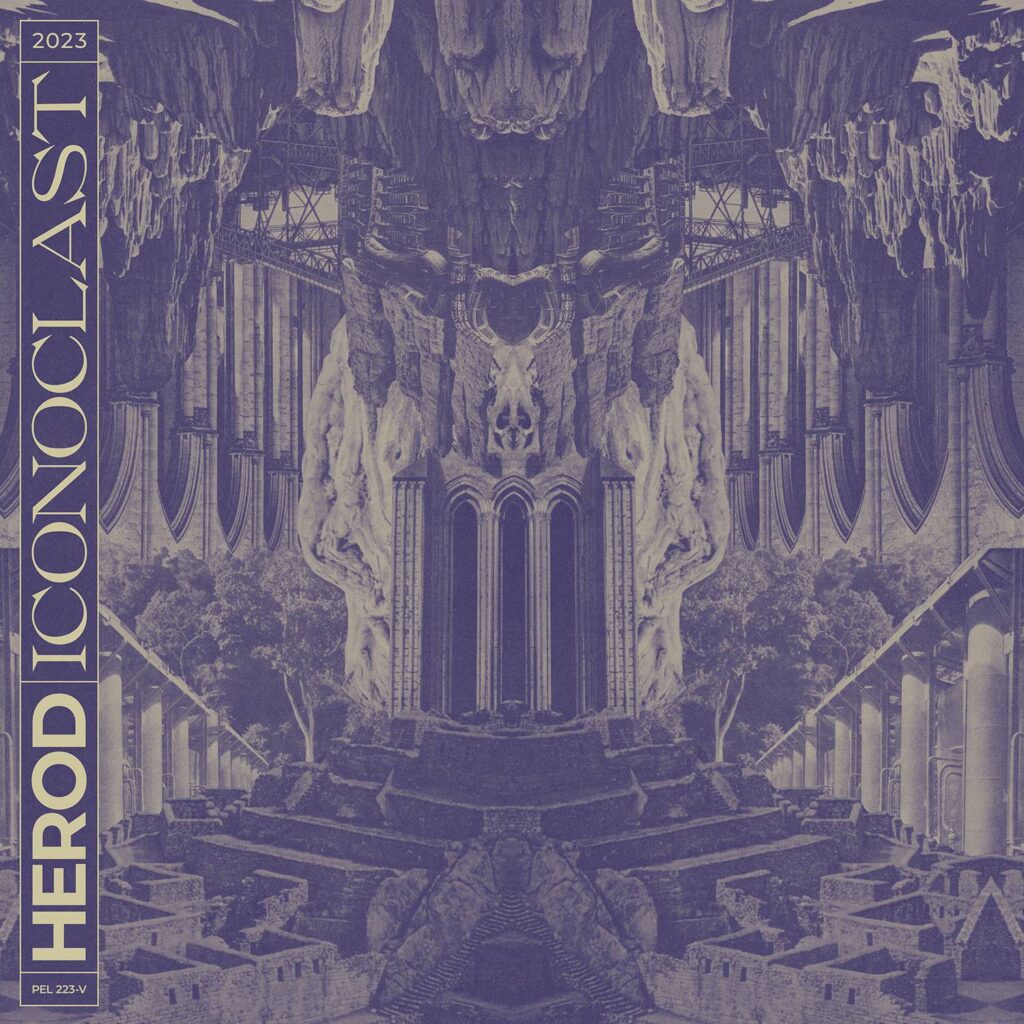
Iconoclast:
A person who attacks or criticises cherished beliefs or institutions.
Herod attempt to exemplify the ideology that; “usually, three types of bands exist: the derivative, the partially fresh if not somewhat original among the derivative mass through luck and those who understand their scene, using that knowledge to channel something ‘truly special’.” Comparing their music to varying legends across the art world from abstract painters such as Jackson Pollock to legendary film score composer Hans Zimmer, Herod certainly consider themselves to be artists as opposed to just musicians. A bold claim indeed when describing new album Iconoclast as; attempting to ‘[redefine] musical heaviness and atmosphere at every turn possible’.
Opening track ‘The Icon’ makes it known immediately that the band wear their influences on their sleeves. Channeling and blending the crushing polyrhythmic aspects of Meshuggah and the atmospheric soundscapes of Cult of Luna into their core repertoire. Opening with a droning, note bending guitar and bass riff, syncopated drums kick in and an angular piercing lead guitar tone cuts through like an alert siren. This breaks into a fairly standard Meshuggah inspired modern metalcore riff, with tremolo shredding and complex, syncopated rhythmic patterns. ‘The Girl With A Balloon’, a nod to the famous piece from Banksy, follows a very similar structure once the reverb soaked droning lead guitar falters, falling back into the twangy djent tones and polyrhythms but moving a bit slower. These big stomping riffs break into a large, open atmospheric soundscape, conveying that blend of the band’s primary influences as the track bounces between the two states.
Iconoclast’s production is par for the course for modern metal, and does a commendable job for the most part, especially when listening to the tonal character of the instrumentation: ‘twangy’, heavily Djent-infused down-tuned guitar tones with a bit more distorted chunk on them, growling low end tones from the bass and the processed punchy sounds of the drums. That being said, there is something strange going on with the kick sound in ‘The Girl With A Balloon’. It has an odd tonal characteristic to it, with a high pitched click accenting the kick drum hits. It wouldn’t normally be worth mentioning, but it’s strangely prevalent on this song alone.
Garnering a lot of buzz and attention with their debut album, Drain have been building a sterling reputation and breathing new life into the NorCal alternative scene. Choosing to build bridges instead of burning them, Living Proof continues the bands exploration into the deep history of the Californian alternative scene. Pulling as much inspiration from old school punk and hardcore bands like Descendants, Black Flag and Circle Jerks, more modern hardcore outfits such as Terror or Trash Talk, crossover legends like Suicidal Tendencies and even nods to the Bay Area Thrash scene. Drain meld all these elements and more together into their own take on the concept of CA focussed crossover.
Opting to kick the door in from the start with album opener ‘Run Your Luck’, Sammy Ciaramitaro’s snarling and explosive delivery of “Run your fucking luck” echoing as the track opens into Drain ferocious crossover chops, seamlessly moving between thrash-tinged riffs and Hardcore breakdown rhythms. The onslaught is near non-stop from front to back. Singles ‘Evil Finds Light’, ‘FTS (KYS)’ and teaser single from 2021 ‘Watch You Burn’ are particular highlights, but each track has more than enough merit to stand on their own and Living Proof is absolutely packed with Hardcore barn-burners. ‘Devil’s Itch’ and ‘Imposter’ are both sure to conjure some eager mosh-pit fodder for their live shows, with the latter being particularly thrash focussed, the tom led intro breaking into the main thrash riff is sure to set crowds alight.

Whilst the queer hardcore two piece where tinkering with their craft long before the release of their 2021 debut LP The Horrible And The Miserable, their debut didn’t capture the attention of the national scene as much as it straight up demanded it. True to it’s namesake, The Horrible And Miserable was 24 minutes of pure resentment and anguish, one that saw the band tackling subjects such as loss, dysmorphia, anguish and self-hatred in a manner so violently self-destructive that even Converge circa 1996 would be concerned. Truly, in the fashion it lashed and attacked itself, it was a record clearly born from pure loathing; both inwardly and outwardly.
Thankfully, in the two years that have passed since it’s release, Death Goals’ Harry Bailey and George Milner have mostly come to make peace with themselves, their identities and their bodies. Such is their new full length endeavour A Garden Of Dead Flowers, a record that bridges the bile of their previous body of work with newfound acceptance. However, an easy listen or pleasant listen this is not. In fact, with the self-resentment of The Horrible And Miserable now pacified, the duo have expand their musical palette, focused their protectory and are now redirecting their musical resentment externally. In laymen’s terms, with A Garden Of Dead Flowers Death Goals have gone from flogging themselves to flogging everyone else and it absolutely rips.
‘Genderless Clones Of Game Show Hosts’ – the wonderfully titled opener – showcases this with all the subtlety to a brick to the forehead. A lived-in tale of having one’s identity erased due to crippling dysmorphia, the track erupts with the aggression and dissonant chords one would associate with the band prior to a chorus of unexpected melody and clean signing. A left-field change for the band yes, but such inclusions are worked into the band’s sound with sublime finesse. In fact, the track only amplifies the impact of the proceeding barrage of the proceeding title track and ‘Ultraviolence’, a song suitably named in thanks to it’s frantic, panic attack inducing breakdown.

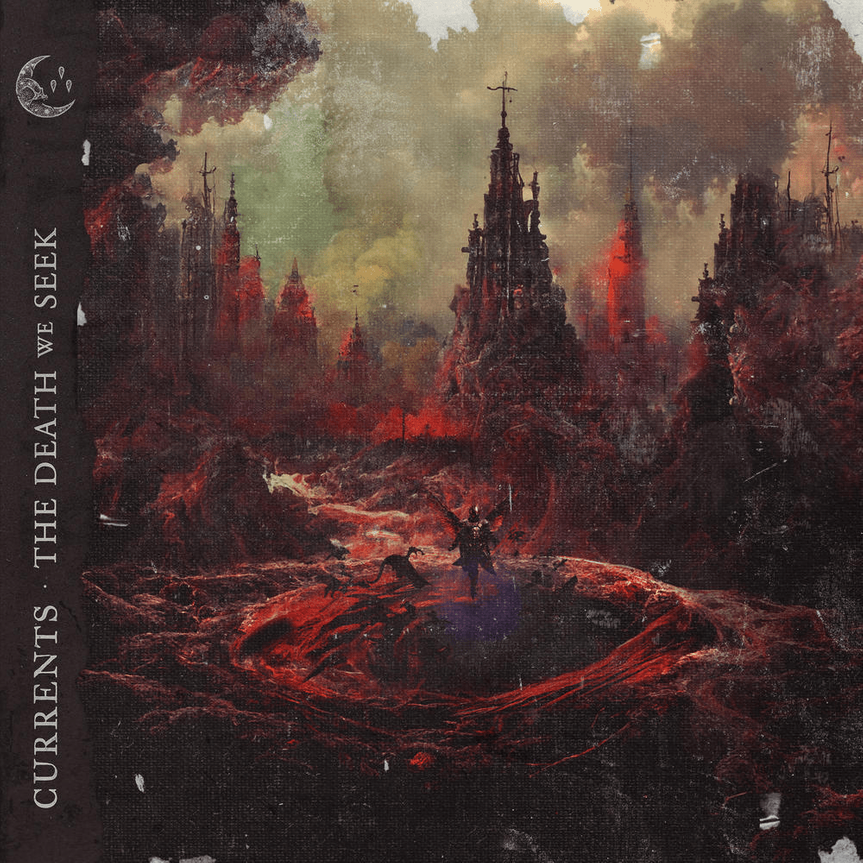
Modern metalcore is something of a poisoned chalice. It may be, to some, a way to take the scene to new heights of accessibility and recognition, but to others it brings up that old elitist war cry of “sell out!”. The key, it seems, to becoming a band that old and new fans flock to in equal measure is balance. Take the heavy, riff focused elements and crushing breakdowns of the past and mix it with the atmospheric, ethereal sounds of the modern day. And what band better encompasses that blend than Currents?
The Death We Seek is their fourth album, three years after the incredibly well received effort The Way It Ends, though as with most albums from 2020 it suffered from being lost in the COVID shuffle. It was a fantastic display and understanding of what a modern metalcore album should be; a mix of powerful emotion, soaring choruses, lush electronic flourishes and some lovely tech-adjacent riffs, leaving fans salivating for what would come next.
We kick things off with the title track and we don’t mess about. Straight in with those atmospheric synths and crushing sonics. One thing that sets Currents apart from other metalcore bands are their epic choruses and cleans. They might not be at Bury Tomorrow‘s level yet but they’re definitely a close second with their melodies and vocalist Brian Wille is only going to get better with time. The high bar continues with ‘Living in Tragedy’, ramping up the heaviness with glorious shrieks and a hell of a stomp in the intro. This is the band on top form, conjuring a swirling vortex of noise and destruction that looks set to level venues all over the world, big and small. Some of these riffs could open up the earth beneath your feet and erupt magma, they’re that intense.
After a rousing one-two punch of solid if familiar breakdowns, techy chugs and stuttering electronics, the pace slows down on ‘Unfamiliar’, a song that doesn’t live up-to the promise of its opening riff. Yes, there’s a solo in there that will raise a few eyebrows but this feels like the first time the record feels a little generic. The clean/scream slower paced metalcore semi-ballad has been done to death and this isn’t one of the better examples of it. Recent single ‘So Alone’ fares a lot better with some of the record’s best melodies and some solid instrumentation throughout, along with showing some of the better uses of subtler, background ambient elements.
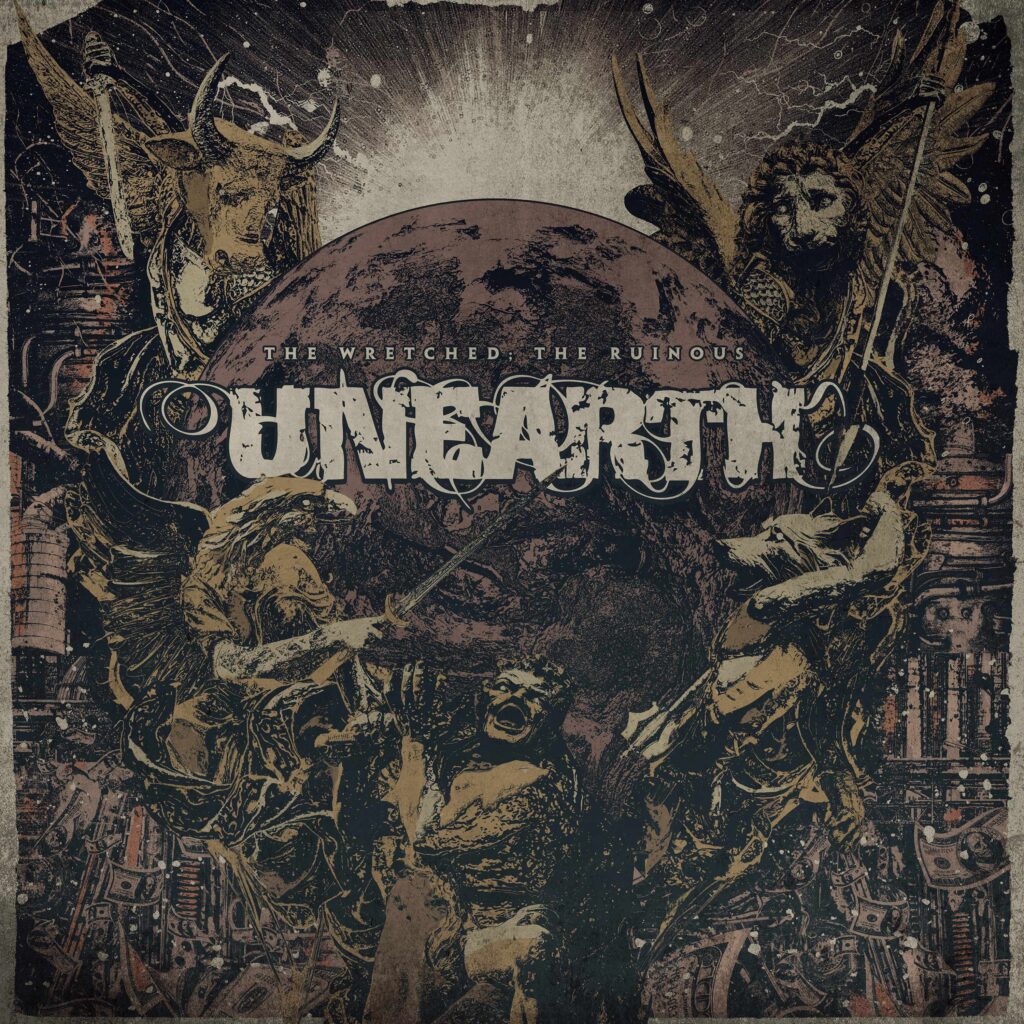
Whatever you’re expecting this to sound like, you’re absolutely right. It sounds like an Unearth album. Hell, if you took this album without any name on to a show and asked people to guess the band, based on the artwork alone they’d probably guess it was Unearth or a band of their ilk. No frills, no deviations from the formula and no quarter given to being heavy as hell, the band are on some of their best form since the mid noughties on this new record.
Titled The Wretched; The Ruinous, it’s the first new music in just over half a decade from the metalcore stalwarts, whose 2018 release Extinction(s) was a little bit hit and miss, yet still a very enjoyable collection of tracks. It showed that despite being a little long in the tooth, they can still go as hard, if not harder than their contemporaries.
No ambient intro tracks here, as the album launches into the massive title track amidst a flurry of drums and some of vocalist Trevor Phipps’ instantly recognizable barks. The riffs soon follow and veteran guitarist Buz Mcgrath is throwing out some guitar work up their with his absolute best. There’s solos scattered across these tracks that wouldn’t feel out of place on a Lamb of God record and it all feels tighter than a tube carriage at rush hour.
Subsequent tracks ‘Cremation Of The Living’ and ‘Eradicator’ throw frenzied blast beats, gang vocals and seismic breakdowns into the mix, as well as bringing some of that gallop the band are known for. The songs batter you all over and you’ll be banging your head and throwing the horns all over your living room. For a band with such an important, serious vocal message and a propensity for creating utterly devastating tracks, they’re incredibly fun. ‘Invictus’, for example, has a part where “Witness The Apocalypse” is screamed and repeated and as ridiculous as it sounds, it makes you feel like you’re on a cliff edge belting it out into the abyss.
Fires in the Distance’s sophomore album is one of epic proportions. Grandiosity and curiosity meet the listener in equal measure, and there is a pervading sense of seriousness. This is not an album to throw on for a stroll in the local park. This is an album meant to be absorbed. Air Not Meant For Us is a grand follow-up to Fires in the Distance’s debut.
For starters, this melodic death/doom band from Connecticut took the best parts of their debut, Echoes, and built something even better. Gorgeous melodies are layered over heavy guitar work, top-notch vocals do not sacrifice an ounce of power for their clarity, restrained drums support the guitars but are never stale, and atmospheric elements pull the epic heights even higher. It is difficult to overstate the epic nature of this album. Creating epic death/doom which possesses the heights of this sophomore effort that does not occasionally dip into cheesy territory is not the easiest of tasks, but Fires in the Distance have done it well.
Themes of Air Not Meant For Us focus on mental health and existentialism, a perfect marriage to the battlefield riffs of Yegor Savonin and Kristian Grimaldi. (Burial in the Sky guitarist James Tomedi provides a beautiful solo on the track “Adrift, Beneath the Listless Waves” for an added guitar texture.) Indeed, every new listen to this album exhumes new textures buried in the mix.


