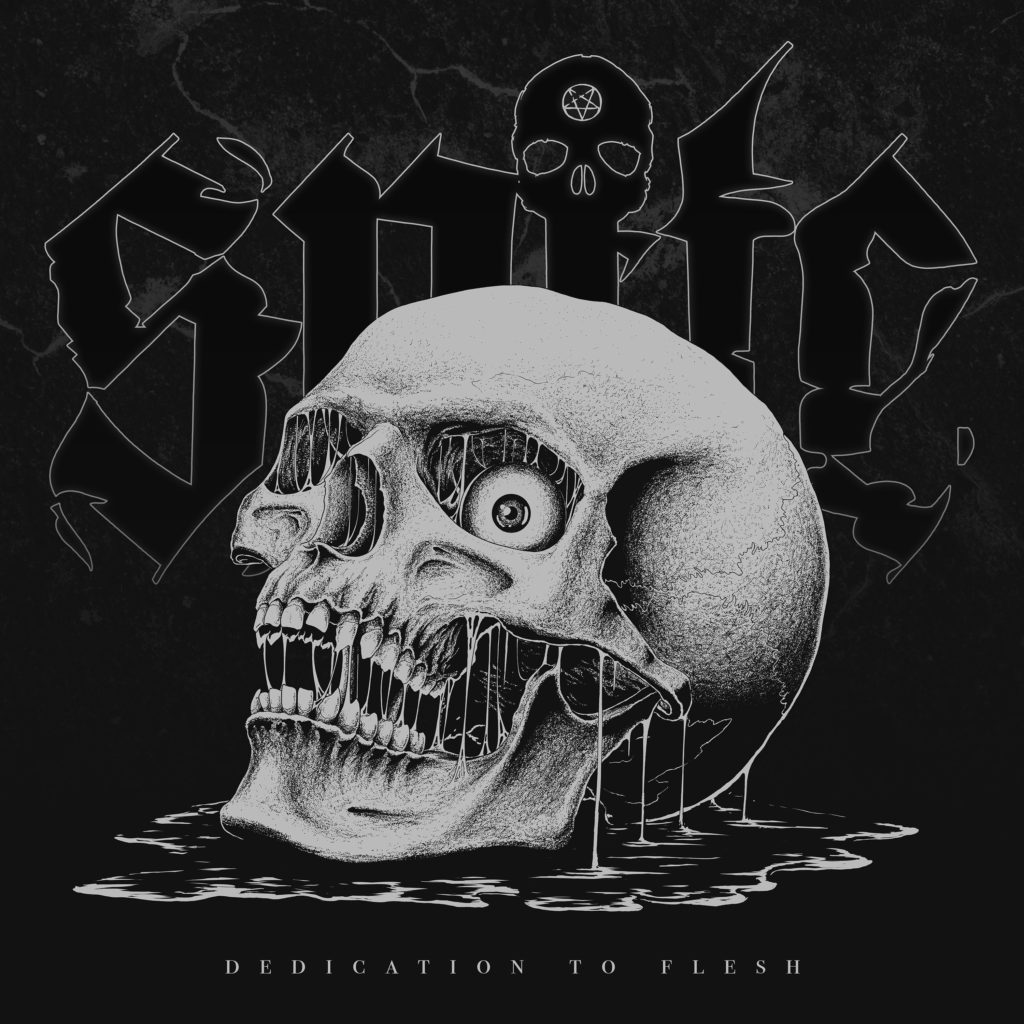
Unleashing an unholy barrage of unbridled chaos, Spite’s ruthlessly brutal approach to deathcore has earned them a fearsome reputation across the USA and beyond. With innovative riffs and production, Spite’s boisterous and bruising, which sound that incorporates elements of death metal, metallic hardcore and a small dose of industrial, sees them as early innovators in within the new resurgence of deathcore that is currently taking place in scenes across the world. This has earned them a spot on this year’s Impericon ‘Never Say Die Tour!’ alongside the likes of Suicide Silence and After The Burial. Now the band’s highly anticipated fourth album, Dedication To Flesh, is about to be let loose to ravage the world.
First things first, you will feel your face contort in a whole host of ways as your appreciate the many ooff moments that this album has. Dedication To Flesh sees Spite up the ante as the band move away from a more hardcore inclined way of writing to a more deathcore centric focus. Constructing bigger and more punchier riffs with infectious grooves that will get you swinging your fists with fury. While the band have incorporated more atmospheric elements in previous releases, Dedication To Flesh has a more unique atmosphere when compared to The Root Of All Evil and Nothing Is Beautiful. In what can only be described as the disembodied voices of lost souls stuck in the devilish purgatory of the modern world, the atmospherics that Spite has utilised throughout the album creates an intense and eerie soundscape, as heavily chugged riffs loom over you like a psychotic surgeon looking to rearrange your face with a terrifying full teeth smile of glee. Wether this is a damming commentary on the state of the world or a brutal alternate reality, Spite’s visceral enrapture alone is enough to terrify you.
Joe Appleford is set to release his ambitious debut album ‘Dystopian Dreams, Utopian Nightmares’, a concept album about the juxtapositions in modern life. Across the record, Appleford takes on different roles to give this record a kaleidoscopic point of view with the design of the album intent on taking the listener on a journey of self-discovery, of worth, value and identity. The solo venture has formed 4 years on from the ashes of Appleford’s previous band Bad Sign, a departure that left him feeling crushed until he was able to pick up an instrument again and even beyond this time. It took some time for the singer to realise that even in his solo work he wanted to achieve large scale sound with big riffs citing The Black Keys and White Stripes as influences for this. A chat with Nana Appleford gave him the kick up the arse he needed to take the demo’s to friend Neil Kennedy and with the help of Static Dress’ Sam Odgen the project was truly born.
Opener ‘Dystopian Dreams’ is as gargantuan as you’d want, need or expect to open an album that boasts arena-sized riffs, complete with a mammoth level of noise that hits like a wall of sound. ‘Silver Lining’ follows to offer melody and grit combined together to craft a swooning bouncier number following the opener, a song about escaping manipulative relationships and knowing your own worth, sets the tone for what’s to come.

Instead, Beautiful Dangerous is a melting pot of pop-synths – bustling at the seams with explosive, flamboyant melodies. Any comparisons between the Brits former work would be futile: he’s chasing something new here.
He quickly puts his effervescent voice to good use – ‘Headache’ has a melodic hook in its chorus that is irresistible. The late 90’s bounce of ‘Patient’ follows suit too. McGough’s ponderings about when to fully commit to love have been well tread, but surrounded in these exuberant tones: they feel fresh.
Admittedly ‘Leave Just Yet’ and ‘Bright Lights’ flirt with the concept of a 90’s disco to the point where it hangs over the edge of being satirical. But, wasn’t that the point? From it’s first moment Beautiful Dangerous presents itself as a purposefully neon painted depiction of love; vices and virtues included.

Every 2-3 years metalcore metaphorically wheels out the five-piece with the intention of showing there’s still gas left in the tank of the genre yet. Metalcore has undergone several metamorphoses (some of them god awful) in the two decades since Norma Jean flourished in its inception; but they have remained a legitimate, dependable outlet.
It’s fitting then that ninth studio album Deathrattle Sing For Me showcases every trope the band have mastered, while showing flirtation with some new musical dice-rolls. There’s a unique intimacy applied to opening track ‘1994’. Its ‘fly on the wall’ like production has Cory Brandan’s raps of “It hurts. It hurts. It hurts” feel like his lips are pursed physically against your eardrum as he rattles off. We’ve never been closer to an in-studio experience.
‘Memorial Hoard’ opts for a moving, sombre tone. Brandan sounds as haunted as he ever has when he mutters “Imagine no possessions. You may say I’m a dreamer.” And the 90 second instrumental to close makes this one of the more obtuse Norma Jean efforts you will ever encounter. In a sense, the record’s at times stance stretches to following track Aria Obscura, too. A meddling, hard rock riff plays centrepiece for a fluctuating tempo until chaos eventually implodes within its pinching middle eight.
By combining lumbering, Black Sabbathian riffage with spacious passages of sadness and introspection and melding gothic and experimental elements, London’s Grave Lines create their own take on the tropes of doom metal, aptly dubbed ‘heavy gloom’. Honing and adding to this formula in the years since their formation in 2015, third album Communion is certainly both heavy and gloomy from the word go.
A blast of feedback ushers opening track ‘Gordian’ into life, before emerging into a chugging stomp with bellowed vocals courtesy of frontman Jake Harding. Before long though the fairly conventional beginnings coagulate oppressive, sludgy mire, as if being pulled apart at the seams, giving way over the concluding minutes into guttural growls and a wall of noise. It’s a bold approach to an opening number, almost inverting the traditional songwriting process by starting with something relatively tight and regimented and purposefully unravelling it, this unorthodox trick is in a sense repeated on the following track ‘Argyraphaga’, which first establishes itself as a pummeling, groove-laden bruiser before falling apart into a gloomy abyss.
Helping to shape the scene and genre alongside a pedigree of acts in the vein of Goodtime Boys, and Brotherhood Of The Lake, it’s futile to even imagine the scene without Bastions‘ input or influence. Upon it’s release eleven years ago, the band’s debut LP Hospital Corners redesigned the sound and aesthetic of UK post-hardcore, becoming the de facto musical ambassador of the scene in the process. Even after all these years, the impact that record made on the scene is still evident and transparent. The texture of the record has become one with the musical tapestry of the genre’s sound, and whenever they know it or not, many a freshly-faced emerging band have tapped into the emotional intensity and profound dissolution that bounded Hospital Corners. Now eleven years since that release – and seven years since their final appearance – Bastions have returned with Majestic Desolation, a record that’s reimposes the band’s pioneering nature and rings true to it’s namesake in a way that’s darkly visceral.
Whilst it would be easy to dub this a comeback record, doing so feels criminally narrow-scoped, especially given the implied connotations. Majestic Desolation feels more akin to being a natural continuation of the sonic themes presented within it’s predecessor as opposed to being something forced and contrived. As the droning interlude of ‘Haas’ into the ironclad sprawls of personal disquiet within previous singles ‘A Broken Crown’ and ‘Acres Of Love’, it’s clear that time has not dulled anything but the band’s appreciation for life. Whilst this does indeed naturally build upon the foundations laid with Hospital Corners, this is no mere nostalgia trip fawning over the bygone days of the post-hardcore scene.
This is a record that feels conscious of it’s existence, a body of work from a band that’s aware of the gravitational shifts that have impacted the scene they once centred. With that in mind, the misery that permeates Bastions’ work has only seemingly quickened with the passing of time. There’s no joy or positivity to be found here, only the sounds of slaughtered youth and existentialist solitude being presented with spacious and atmospheric rage.