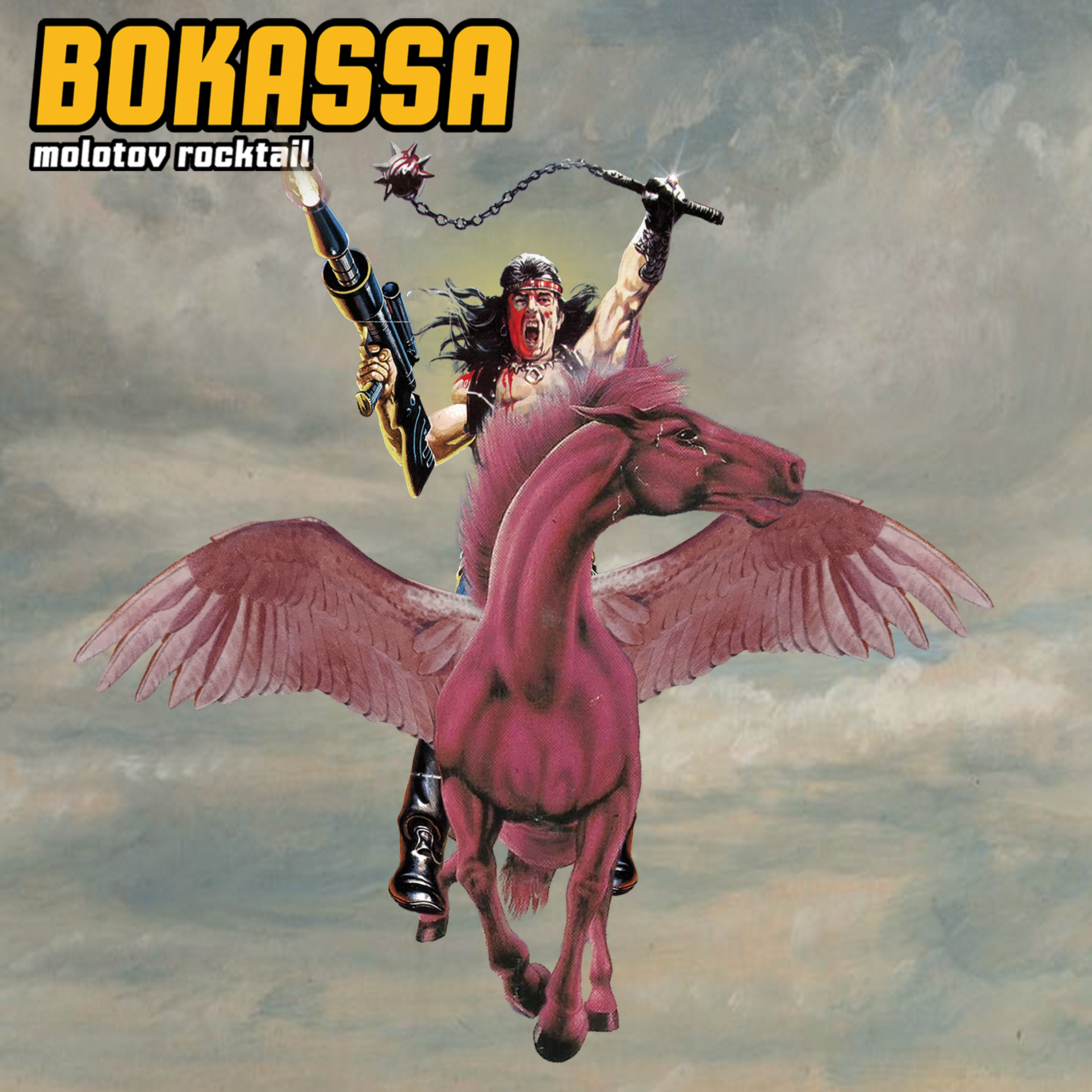
Norwegian power trio Bokassa have had the kind of career moments that many bands would surely envy; they’ve opened for Metallica and Lars Ulrich even declared them his new favourite band, for one thing. It’s a good thing, then, that the band have got not only the chops but the songs and the attitude to back up that kind of confidence. Their latest album Molotov Rocktail is an incendiary mix of stoner rock, punk grit and exudes sheer fun and raucous energy from start to finish.
Opening with the brief ‘Freelude’, a lone guitar builds into a chugging riff that barely hints at the carnage to come. The rumbling bass of ‘So Long Idiots’, though, bounds out the gates with glee. It serves up chaotic punk rock energy with an arena-sized chorus that practically demands a singalong. ‘Pitchforks R Us’ keeps that energy coming with its rollicking groove and snarling vocal hooks. The band manage to cram in more hooks than a fishing convention; there’s an anarchic, old school punk feel meshed alongside big stoner grooves like the aforementioned ‘Pitchforks R Us’ and ‘Low (And Behold)’.
Leading with the blistering ‘Quit Your Jobs’, which rockets along with all the grace of a speeding freight train hijacked by adrenaline junkies, the band waste no time in re-assuring fans that when it comes to the music, nothing has changed, and if anything, the freshly ignited fire of their new found freedom shines through. ‘Amateur Dramatics’ drops the bolstered speed in exchange for an absolutely stonking great chorus, ready to shred the vocal chords of any fan who wants to sing it back at a show. The unhinged tones of the guitar here compliment the theme of trepidation in the lyricism here, while Matt screams “try not to panic!”, a message sure to resonate with many of us living under the current state of affairs right now.
Then comes ‘Water Me Down’, and the headbanging hasn’t stopped yet, there’s a lot of pent up aggression and frustration being unleashed here. A lot of the lyrics understandably so come from the bands recent experience feeling held back, (or perhaps, watered down) by record label politics, and Cheer Up serves as their freedom cry. A roller-coaster ride that doesn’t relent, ‘Fucking TV’ continues these themes as well, the steady rhythm of the drums boosting the frenetic distortion of the guitar. This is Haggard Cat as we know and love them, but this time they’re really, really pissed off.
Glow On was released yesterday by none other than the bands long standing partner Roadrunner Records, and from the opening notes it is clear that the next fifteen tracks are certain to contain the quintets most diverse body of work to date.
Since the very start of the project’s origin story, Turnstile have built their fearsome reputation from the ground up – consisting of big riffs, even larger breakdowns and high octane live shows where there are more stage dives than ticket holders. Whilst still retaining instinctual elements of their signature sound, there’s something further at play with their latest release than just a standard hardcore record. Scattered throughout there are specific elements that are almost cinematic, and these subtleties overall deliver an LP with a retrospective, and almost extraterrestrial feel. Turnstile have broadened their horizons and charged headlong into the unexpected, with grooves aplenty and a melodic undertone much more prevalent here than in some of their previous work.
Up there as one of the most extreme metal albums you are likely to hear this year, Stalker is an all-star onslaught featuring an impressive list of guest artists including the likes of Baard Kolstad from Leprous and Mike Moran, the actual keyboardist for both Ozzy Osbourne and George Harrison. Aside from a host of guest musicians, the band itself is just John Bailey and Corrupt Moral Altar vocalist Chris Reese. For a debut, it’s pretty impressive, damn near startling and it’s obvious these guys know what they’re doing. Strap in, you’re in for a rocky ride.
Opening track ‘The Bus Station Roof’ is the perfect example of the kind of experimental tech metal on offer throughout the record. The first eight seconds are ear-drum bursting insanely heavy scream-filled noise. Then it breaks out into a sort of chilled out jazz-like section, as if you’re stood in an elevator that’s just arisen from the depths of the void itself. It’s the bass that drives these delicate sections, adding a sort of quirky charm to the track and a respite from the onslaught, although it still sounds like it’s the inner thoughts of a highly deranged mind driven insane from knowing all the possible configurations of music. From here, the track changes completely about a minute and a half in into something totally different. There’s multiple dropouts, changes and transitions in the opener alone, which gives you an idea of what’s to come.
When we can’t achieve this, such failures leads to confusion, frustration and obsession. It’s possibly this mental obligation that has led to the rapid and prominent rise of Sugar Horse.
To try and neatly pin down Sugar Horse is essentially a nigh-on fruitless task. Emerging from the fertile grounds of the Bristolian scene back at the tail end of the last decade like some sort of strange and remarkable fungi, the band have quickly gathered a reputation for their staunch nonconformist approach. From a slew of stand-alone singles and their two initial EPs – 2019’s DRUJ and 2020’s DRUGS respectively – the band have indoctrinated entire ranges of genres and stylistics to create a sound that’s impressionable and strikingly unique. One could easily assign tags such post-metal, shoegaze, doom, noise-rock and post-hardcore to their sound and be correct in their assumptions but still entirely miss the mark due to the limitations of such associations. So with that in mind, some may anticipate and hope Sugar Horse’s long anticipated LP debut would allow them to finally perceive in an understandable and cohesive manner; and for all intents and purposes, it does allow that, albeit in an ever-so abstract way.
In affect and for the most part, The Live Long After is essentially the platform that allows Sugar Horse to further refine and augment the tones, styles and atmospheres that composed their work prior. Whilst the aforementioned EPs where brilliant exercises in unbridled genre dynamism, it did ultimately feel as if the format of the extended play limited the band’s vision. As anyone who has experienced the band thus far will undoubtedly know, Sugar Horse are a band that have a total disregard for urgency and opt to explore their ideas through glacial, churning paces. So with that in mind, it’s no surprise that The Long Live After feels like a comfortably composed piece. Sugar Horse have managed to amalgamate and further ponder their musical exercises in a natural and organic way all whilst further treading new waters all whilst allowing their sardonic, fatal and often absurdist attitude to be articulated with a more expanded vocabulary.

This couldn’t be further from the case for Jinjer. Releasing on August 27, their third album Wallflowers rips the buds from the wall and hurls them into the spotlight. Following their game changing Macro, Wallflowers is a harsh examination of the past year. Delving into the wealth of inspiration this Covid world has provided, Jinjer throw us to the wolves of our own creation.
“I’m overthrown with self love” Tatiana Shmayluk’s revitalised anger screams in ‘Call Me A Symbol’. From the off, we hear Jinjer revelling in blurred genres. The brutality of hardcore’s double kick collides with winding guitars of grunge. This heady blend of viciousness grabs us by the scruff of the neck as Shmayluk demands our attention with larynx lacerating roars. The soulful clean vocal of “let me feel my evil” breeds the courage we all need to assert ourselves in a world vying to crush us. The spiral into decadence shortly after with meaty riffs from Roman Ibramkhalilov powered by Vlad Ulasevich’s unravelling beat is nothing short of divine.
‘Call Me A Symbol’ opens the door to a realm of personal reflection. Jinjer’s mission statement with Wallflowers was to expose the truth that not all introspection is pretty to look at. ‘Copycat’ examines platonic relationships which have been tainted by jealousy. Dense riffs hit us like a freight train. We expect massive roars so the introductory clean vocals take us aback. Keeping us on our toes is Jinjer’s favourite game. ‘Disclosure!’ starts with a sucker-punch riff churning under sweet cleans. Its frantic nature soon comes out to play. “Let’s play this mind game” exposes not only the song’s identity but rips the mask from the duplicitous subject.