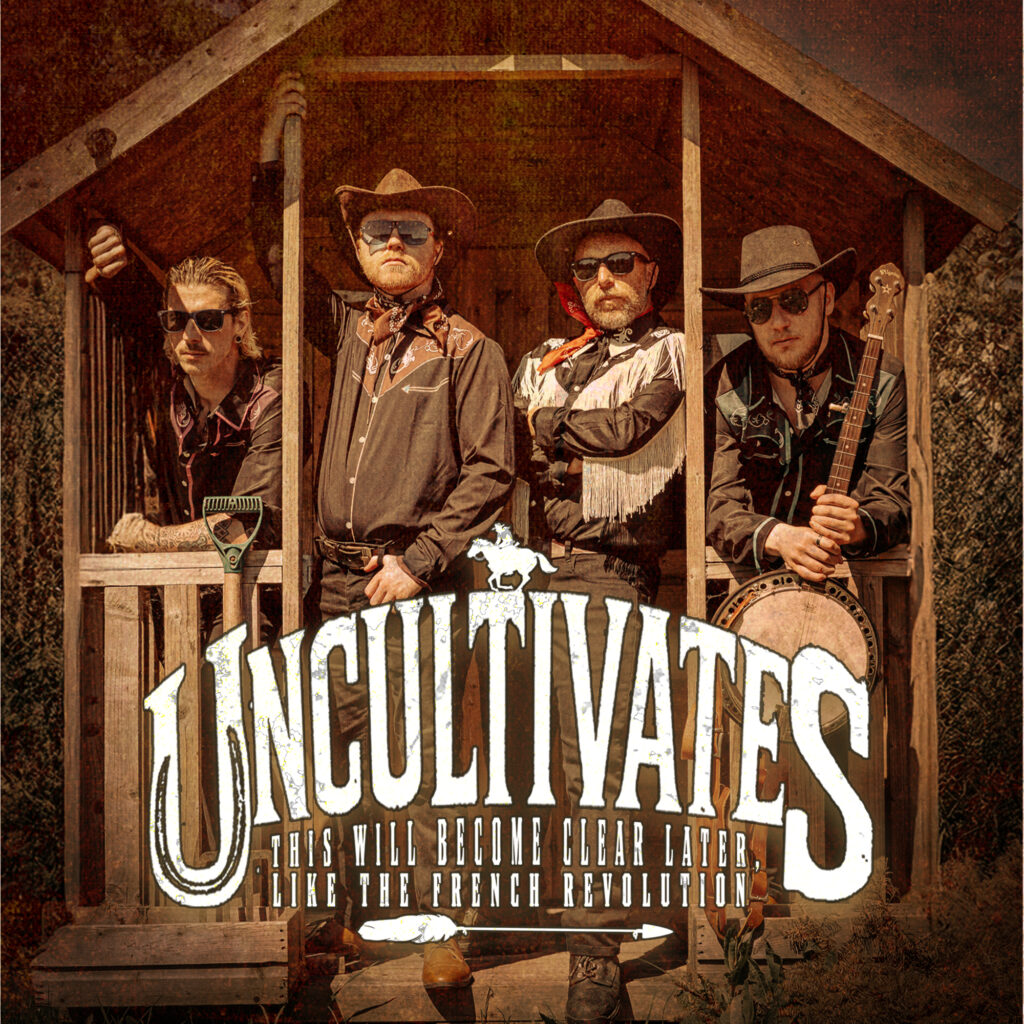
Riding in on a dark stallion comes one of the most intriguing bands to come out of the Irish heavy music scene in many a moon, Uncultivates. In the year since their debut single, word’s got around about this chaotic new four-piece from Cork, fuelled by their live shows alongside acts like Mastiff, Party Cannon and Gamma Bomb. Now with their debut album This Will Become Clear Later, Like The French Revolution, Uncultivates are ready to not only throw down some of the rootin’est, tootin’est riffs this side of the Mississippi but also prove that there’s more to them than the cowboy hats.
After a short intro in which the vocalist known only as Dr. Eli Gravedigger boots in the doors of a bustling saloon to demand the listener’s attention, the album kicks off in earnest with the track ‘I Am Your God Your Father And Your Boss’. While fans of acts like Every Time I Die and ‘68 are sure to find their mix of southern charm and brutal hardcore riffs familiar, Uncultivates waste no time in setting themselves apart, with their opening track the Cork four launch straight into three minutes of choppy beats, country-picked guitars and relentless screams which sounds like nothing you’ve heard before. The road Uncultivates have found themselves on isn’t completely untravelled but few bands ride it with the same erratic pace and unhinged grin they do.
Eight years after their tragic break-up sent shock waves through the British metal landscape. Shields are back with their second studio album, Death & Connection. But with this long of a break, it makes you wonder if the band have anything left in the tank. As you press play on the album, you’re greeted to an almost five minute spoken word poem piece backed by howling winds and an increasingly never-ending hate filled rant. Hardly a prelude to the explosive comeback you’d expect. That comes next in the form of ‘Abuser’ with the band exploding into fury as Joe Edwards’ vocals strike with venomous precision. New drummer Alastair Wain proves his worth with a flurry of blast beats and at times slower out of time hits that make ‘Abuser’ complex and inhospitable.
Then, the rest of the album follows. A shallow attempt to come back and sit upon the throne they once inhabited, however, they fall far from reaching the height they obtained back in 2018. The album is a copy and paste formula without a shred of originally weaved into the mix. ‘Kill’ has one of the worst spoken-rap passages in modern music that feels like it was added at the last second, which is then backed up by some tacky auto-tuned enhanced clean vocals. While this isn’t inherently a bad thing, as it can help to boost backing vocals in some capacity, but here it feels lifeless and oozes second hand embarrassment. Samuel Finney’s guitar sound, while crushingly heavy, is empty with nary a riff in sight, which is a shame because we know he’s capable of greater things.
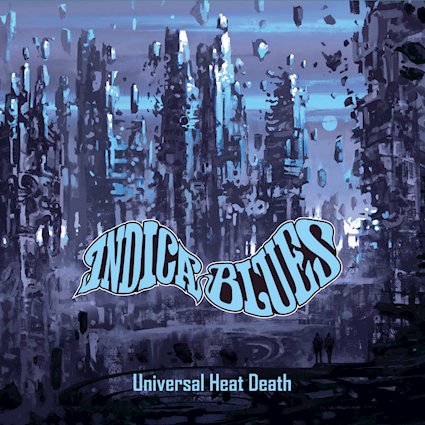
With the state of, well *gestures broadly at everything*, sometimes you need music to help you escape, to distract from the crumbling society around you and remind you there is still hope. Other times, though, it’s good to put something on that holds a mirror up and helps you make sense of the madness by confronting it head on. With Universal Heat Death, Oxford based stoner-metal crew Indica Blues have created an album that does the latter. Across its seven tracks it tussles with apocalyptic questions of what happens at the end of humanity itself, via the medium of raw yet melodic riff worship.
It’s been five years and a global pandemic since Indica Blues released their strangely prophetic previous record We Are Doomed. In the intervening years it’s not as if they’ve torn up the stoner/doom rule book to pieces, but they’ve certainly honed their chops. The influences of the likes of Electric Wizard, Kyuss, Clutch and Fu Manchu are still all over this record, but there’s also a marked improvement in the performances and songwriting. The riffs feel more self assured, there’s moments of pure brilliance in the dual guitar harmonies that are peppered throughout, the song structures are taught, and there’s a greater sense of melody than has ever been present on their previous offerings.
The tone is set from the off with the title track. Given the amount of ideas they pack into its three and a half minute run time, it feels longer than it actually is. This isn’t a bad thing; less disciplined bands would have stretched this out into an eight-minuter, and it would have suffered for it.
When they do venture into the seven-plus-minute territory later on the album in the form of ‘Debt Ridden Blues’ and Bloodsands II it’s not without purpose. The slow, bluesy shuffle of the former and the hazy atmosphere of the latter call for a more meditative approach.
Everyone knows that someone who doesn’t seem to age. Whether they practice black magic or won the genetic lottery, they’ve managed to whether the sands of time to continue looking the same as they did 20 years ago. In the prog world, Perth’s Karnivool is this aforementioned would-be immortal.
Since they exploded onto the scene with their 2005 Platinum-certified debut LP Themata, the Australian prog juggernauts have maintained a level of reverance and consistency that few bands can sustain. Now, after 12 years of waiting, a new album is imminent and the tension couldn’t be higher.
With the amount of time that has passed, you’d think most fans would have been happy with just a drawing of Ian Kenny on a paper plate singing the alphabet, but Karnivool enjoyers can expect an absolute delight upon release. Karnivool have never released a mediocre album and they aren’t starting in 2026.
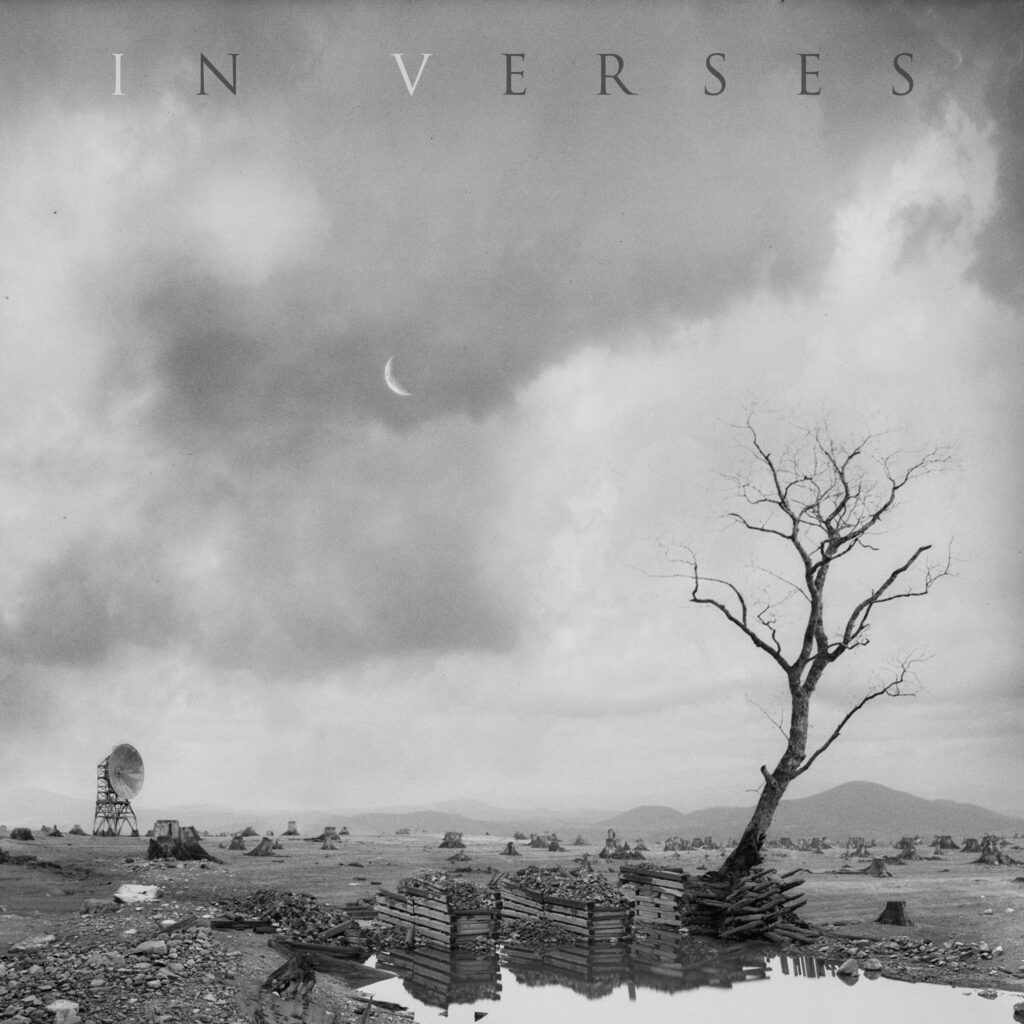
In Verses begins in a quiet, reserved place, with the opening murmurs of ‘Ghost’ sounding less massive riffs and more Massive Attack. It doesn’t take long for the energy to ramp up, however, and the wide, rich mix of long-time collaborator Forrester Savell comes rushing into the ears, sending shivers down the spine.
Drummer Steve Judd’s intelligent playing ensures that the listener can navigate the most intense and complex sections of noise that guitarists Drew Goddard and Mark Hosking lay down throughout the more chaotic moments.
Time has not dulled the band’s keen sound and it certainly hasn’t dulled the grit on Jon Stockman’s strings, as his immaculate bass playing perfectly wraps around the backbone of the album. Soft, subtle, sometimes snaky passages hover in the background of some sections, before becoming a low, throaty roar.
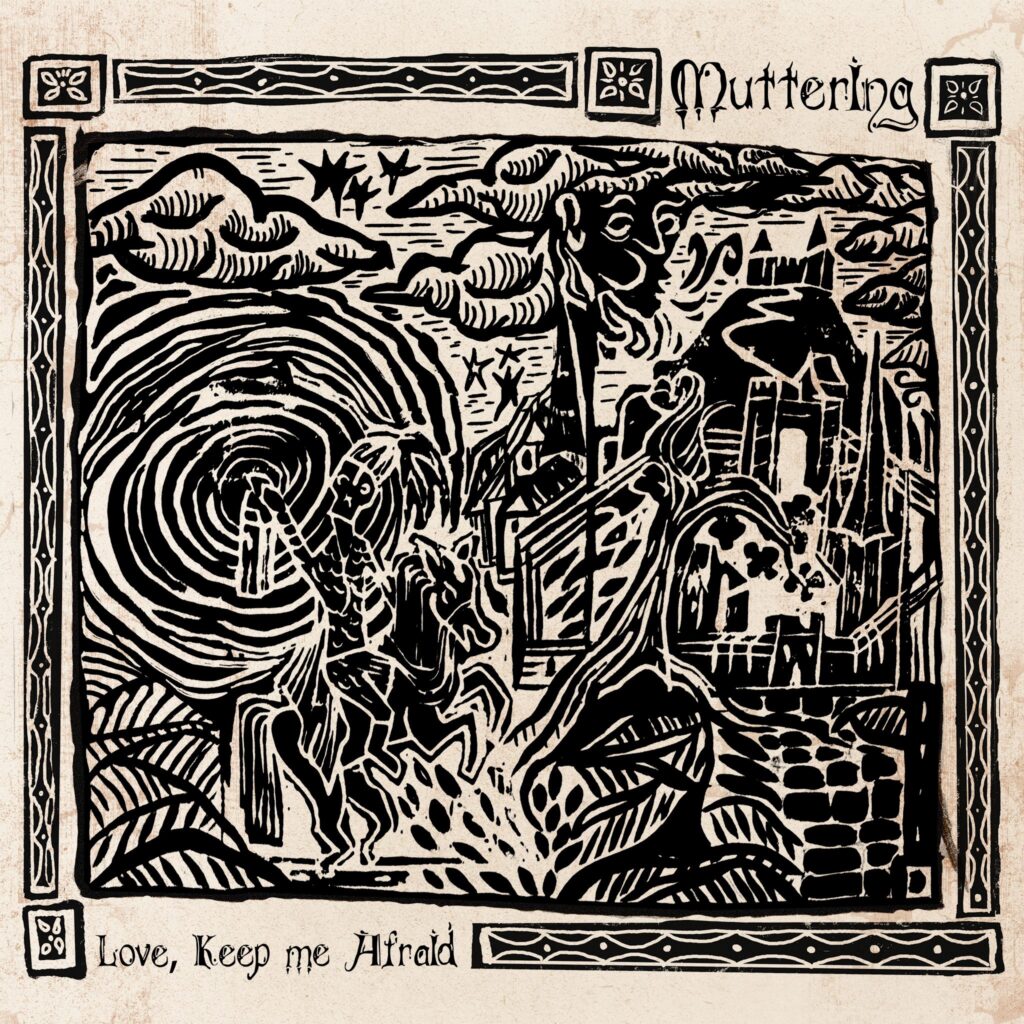
Muttering have been a staple of the UK emo scene for a few years now. More crucially, they’ve been a consistent one. Between their brilliant initial offerings, their suitably titled 2022 LP Great and the criminally under-sung collaborative EP they released with Soot Sprite in 2024, Muttering have swiftly become a dotted presence within the post-pandemic UK emo scene. Yet, beyond the cosy confines of said scene, they’re a trio yet to be gifted their flowers. A shame, for they’re more than deserving of such wider praise. But if there’s any justice in the world Love, Keep Me Afraid should see the band being buried under such proverbial banquets.
The second LP from the Brighton / London three-piece, Love, Keep Me Afraid, like most records of this nature, is a record on the nature of love of loss in a world severely lacking in the former and abundant in the latter. But unlike the stereotypical perception held by many regarding records such as these, this isn’t a record of adolescent self-pity expressed by lacklustre men who struggle to both understand and express complex emotions. It’s quite the opposite in fact. Much akin to the work that came before this record, here, Muttering document the complexly bittersweet nature of longing with the kind of matured and sophisticated articulation it demands. The end result is undoubtedly the first great emo-adjacent record of 2026.
A record that shy’s away from the giddiness and woe-is-me-and-me-only angst that has become to define the emo soundscape post-pandemic, the muses on love and loss here are more tender probings of the subject than just messy outpourings of personal misery. It’s this considered and gentle approach that allows this record to truly capture such mercurial emotions in a way that’s tangible to an intimate degree.
The punchy, immediate and grabbing opening gambit of ‘Somehow’, ‘Saturday Afternoon’ and ‘Holding You Back’ encapsulates this sentiment from the get-go, with this trio of tracks not only highlighting Muttering’s driving and inspired approach to the genre, but also the brilliant lyricism of vocalist Charlie Bush. In a way that’s reminiscent of both the band’s fellow scene mates such as the aforementioned Soot Sprite as well as genre pioneers such as American Football, the fashion in which Bush is able to articulate emotions often inexpressible is just brilliant and arresting. It’s a far cry from the juvenility many correlate to this genre.